Thursday, February 20, 2014

Mapping My Online Portfolio (02/20/14)

In my Game Art course this semester I am rendering a 3D model of a room. I like working with the Maya program and am looking forward to doing some more animations with it. This led me to the Graphic Artist Guild Handbook to research careers in video game art, I have learned that there are many, including animator, which interests me. Unfortunately, I have also learned that outsourcing has diminished some opportunities in the United States. Graphic Artist Guild Handbook, states, “Art can easily be created and refined outside the main studio, so it’s easy for companies to send art-based work overseas, where labor is cheaper.” (pg. 206) To increase an video game artists opportunities it is important to have technical knowledge in programming and to keep up with the ever changing technology as well as have artistic talent.


I remind myself to concentrate on my portfolio.
My first task to to redesign my business cards, letterhead and envelopes. I feel that I have a better handle on what design I am looking for. I have designed a much simpler, cleaner looking brand. I decided to use black and red as my colors and I am happy with my designs.


Today I am going to develop the information architect for my website. My online portfolio will be seen by a lot more people than my portfolio book. A lot of thought and planning needs to be put into it.  It needs to show off my work while being easy to navigate.  Larry Volk and Danielle Currier states in No Plastic Sleeves, “It’s guaranteed to be impressive if all the components of your portfolio are designed with the same conceptual and visual brand in mind.” (pg. 146) This brings me back to my brand board. My brand board keeps me focused on the look I want to achieve. Research says to keep the portfolio simple, clear, consistent, memorable and confident.


Designing the information architecture took more time and effort that I originally thought. In No Plastic Sleeves, the authors advise, “Consider how your website portfolio will be used. What kinds of functionality (means for someone to navigate and experience the website) will be included?” (pg. 149)


Sources
Graphic Artists Guild Handbook Pricing and Ethical Guidelines. 14th ed. New York: Graphic Artists Guild, 2013. Print.

Volk, Larry, and Danielle Currier. The Complete Portfolio Guide for Photographers and Designers. New York: Focal, 2010. Print.

Thursday, February 13, 2014

Here's My Card (02/13/14)

This week I had a few things to get started on towards creating my portfolio.
I am becoming more and more aware of just how essential my portfolio is. It will be a way for me to market myself in a competitive world.

I have to begin to organize and collect all the work I have created. As I look my work over I know that I will need to tweak or to re-do some pieces.  But before I consider that, I need to decide exactly what direction I would like to go in. What story will I like to tell, and who do I want to tell my story to? From my readings in No Plastic Sleeves, I have found out that somewhere around 12 pieces of work seems to be a good number for my portfolio. Quality is more important than quantity and that although all pieces must be good, it is advisable to lead with and to end with my best pieces. No Plastic Sleeves also emphasis the importance the process book is in helping to convey my thought process. By showing my potential employer my process, I am able to present a better picture of who I am. I will keep all of this in mind when deciding on my pieces.

But first I need to decide what my identity design would be. What is my brand?  I know that I would like to do animation. It is what I enjoy the most and what I am most proud of.  In reading The Graphic Artists Guild Handbook, I am reminded of all the areas that an animator can work. Animation companies, the movie industry and the gaming industry are just a few places an animator can find work. That is good news. The not so good news is, the industry is very competitive. It is a desirable and popular profession and many U. S. companies hire outside the country.This is more reason why I need to do a good job in conveying my brand in my portfolio.

How do I tell a story about who I am as a creative professional? That is not easy. No Plastic Sleeves gave a few exercises that are helpful in this. I started with listing 5 words to describe myself.  dedicated, patient, detail oriented, considerate, gamer.
Then I tried the brand statement. “I am an animator with strong skills with Adobe Flash and Maya who is dedicated, thorough and detail oriented. I have a strong belief that animation has infinite possibilities.”

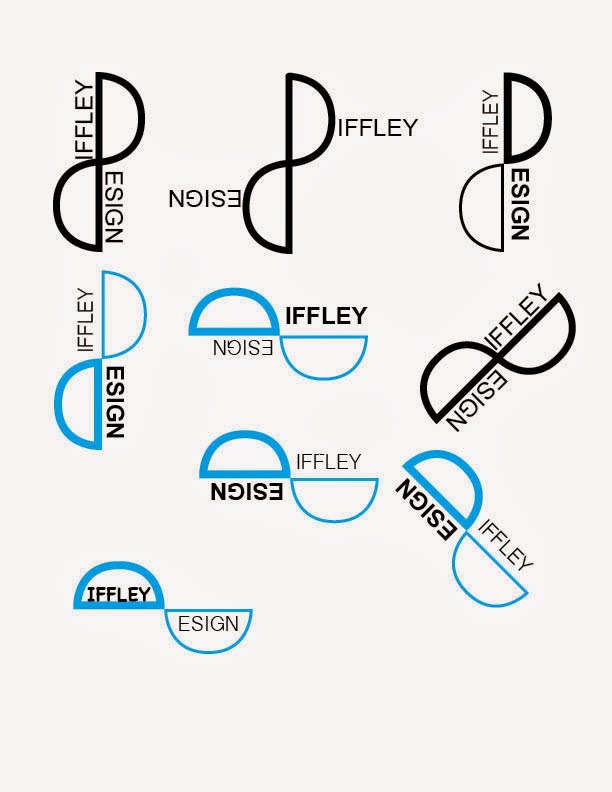
My logo is an infinity sign shaped like a D for my last name. I believe that there are an infinite amount of ideas. Some ideas on based on others but can be developed and created into whole new ideas. Now it is time to design a business card, letterhead and envelopes using my logo.

In looking for inspiration for business cards, I came across the February 4, 2014, Wall Street Journal article, “The Business Card Cannot Be Killed”, by Joanna Stern. I recommend this article because it talked about the different apps being developed to scan the business card. It was at first surprising to me that the business card is not obsolete in today’s day and age of technology. It seems however according to Stern’s article that the technology is not quite there yet. But as I thought more about the business card I see the importance of having it in your hands. The visual image of the card can quickly bring up an image of the person. To get more research I looked at the book, The Best of Business Card Design 6: No. 6 by Blackcoffee Design, Inc. The book states, “In this digital age of laptop, cellular phones and PDAs the business card has ironically proliferated. The more memorable the card the more memorable the contact.” p.6. The book gives 400 examples of cards that communicates information in a legible manner. It based its criteria on functionality, communication and wow factor.

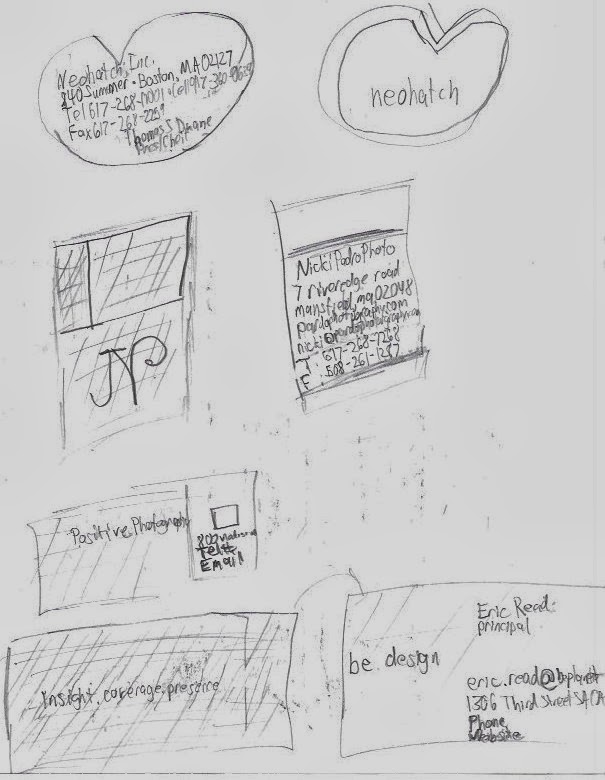
Here I sketched a few of my favorites.


Time to start designing my own. Here are some business cards, letterheads and envelopes.

Sketches:


Business Cards:


 Envelopes:


 Stationaries:


Sources
Blackcoffee Designs Inc, comp. The Best of Business Card Design 6:No.6. Gloucester: Rockport, 2004. Print.
Graphic Artists Guild Handbook Pricing and Ethical Guidelines. 14th ed. New York: Graphic Artists Guild, 2013. Print.
Stern, Joanna. “The Business Card Cannot Be Killed.” The Wall Street Journal. N.p., 4 Feb. 2014. Web. 8 Feb. 2014.

Volk, Larry, and Danielle Currier. The Complete Portfolio Guide for Photographers and Designers. New York: Focal, 2010. Print.

Wednesday, February 5, 2014

Back to the Sketch Pad

After Friday’s class critique I have gone back to the sketch pad. But first I checked out Pinterest again for inspiration:

http://www.pinterest.com/jfdiffley/logos/

I also read David Airey’s blog. Graphic Designer David Airey gave ten steps to creating a logo. Essentially all of them was to sketch and sketch some more. His advise was not to be concerned about mistakes and to understand that can take many misses in order to get a hit. I drew encouragement from his words of advise.


I also read David Airey’s blog on his own personal logo project. Airey sketched over a hundred personal logo designs before he hit upon one he liked. I found his advise and his own experiences encouraging as I struggled with my own personal logo designs.


Here are just a few of David Airey’s sketches.


As I sketched, I asked myself about design and about myself. I stopped worrying about ideas that were done before or seemed too cliche, I just kept sketching.
Here are some of my ideas:


I tried a few comps just to see how they looked:


Sources
Airey, David. “Personal Logo Sketches.” David Airey. N.p., 7 May 2007. Web. 2 Feb. 2014.

- - -. “10 Steps to Great Logo Design.” David Airey. N.p., 29 July 2007. Web. 2 Feb. 2014.

Mind Mapping:

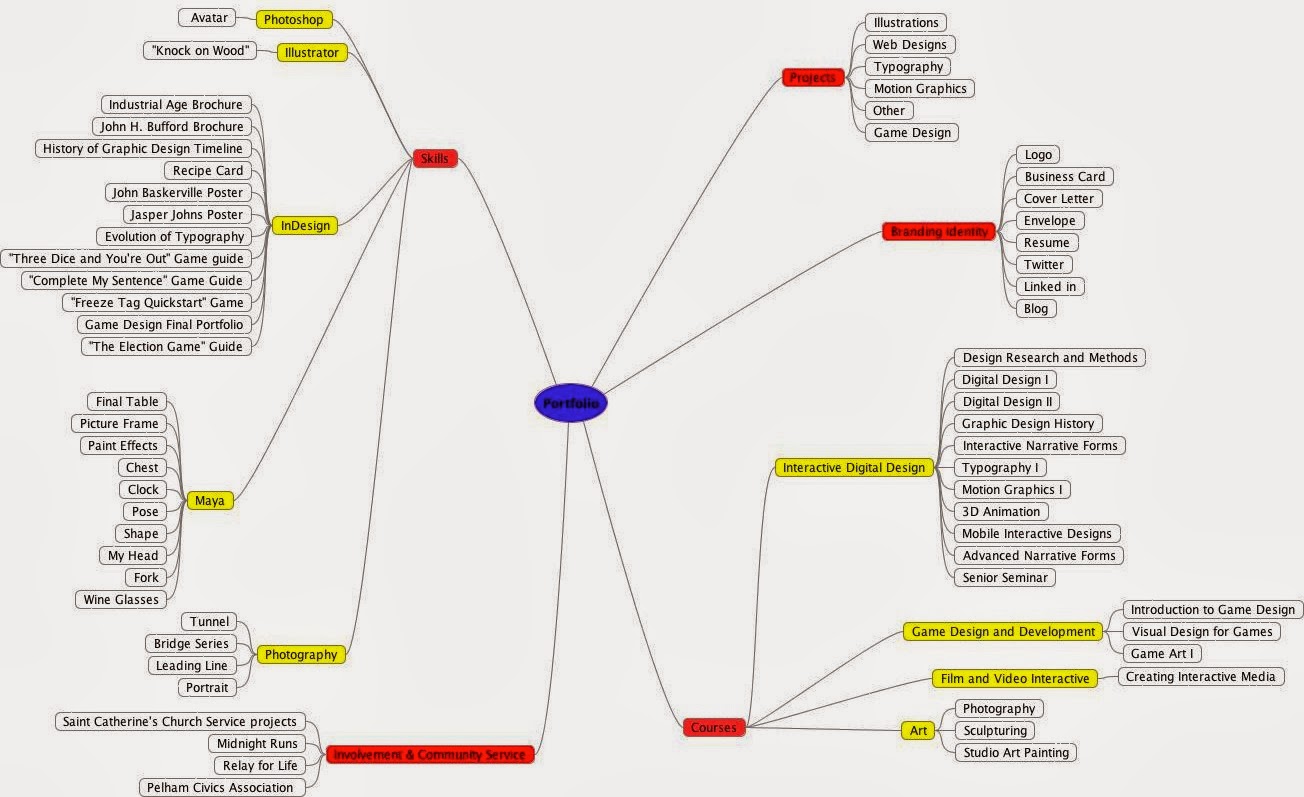
After Friday’s class critique, I had some work to do on my Mind Map. Instead of listing what programmed I used for the projects, Professor Hastings suggested I list my projects under what type of project they were. For example all my game designs would be listed under Game Development Design.

Everything looks clearer to me:

Thursday, January 30, 2014

...Go! (01/30/14)

Next step, I need to develop a logo. I appreciate logos and understand their influence. I researched on Behance, as well as looked at the portfolios of the Class of ‘13 and ‘12 and  I am in awe of some of the simple and yet effective and creative logos people come up with.


Now how I am I going to come up with a logo that is good, unique and represents me? Dryicons article, “Logo Design Process Tutorials” was a great place to start. It laid out in easy to follow steps how to create a logo. The hardest step was to detail a design brief based on myself. Larry Volk wrote in, No Plastic Sleeves, “You will need to develop a brand statement for yourself , capitalizing on your unique abilities and creative vision.” At the same time Malcom Grear recommends in “Inside|Outside Design, “Simplicity, clarity and elegance.  Such simplicity is hard to acheive.”  What represents me? I thought about asking friends and family for help. But decided that that is a hard thing to ask a friend. My parents are totally biased. And asking my siblings? Well, that would be setting myself up for some joking. So I relied on myself to write down my likes, dislikes, personality traits and how I would like myself to be represented. My favorite courses at Quinnipiac were the animation classes. I hope to have a career in animation, so I wanted my logo to hopefully represent that. Last semester I took Creating Interactive Media. It was such a fun class. My professor encouraged me to carry my animated “Stickman” character throughout the semester’s projects. I thought perhaps I would resurrect Stickman. My other ideas all revolved around the concepts that my ideas start small and evolve into big things. Acorn? Snowman?? (It’s been a long winter!) I started to sketch.


Here are some of my sketches:


Ready, Set…. (01/30/14)

To me, a common characteristic of an older person was one, that they always commented that time went by so fast, and two, they complained about the cold weather and snow. Well, I think I am getting older….


Where did the time go? Seems hard to believe that I have just started my last semester of college. When I started my first semester in August 2010 this day seemed impossible to imagine. I had no idea what was ahead of me. All I knew at that time was that the idea of college life was exciting, scary and so daunting! But with one foot in front of the other, and one step at a time, here I am, in a blink of an eye. Now I am faced with another exciting, scary and so daunting new phase in my life. But to get there, I need a portfolio.


I started reading No Plastic Sleeves:The Complete Portfolio Guide for Photographers and Designers, by Larry Volk. Volk wrote, ‘Your portfolio needs to get noticed, grab someone’s attention, and distinguish you from “the crowd”. That is a big order to fill.


First step was creating a Mind Map in FreeMind. To me this was very satisfying. It quickly put all my courses, my projects, my skills, my experiences into an organized visual tool for me.  Thank you Tony Buzan. Wow! I covered a lot in four years.


I am looking forward to the Spring. I am excited to having a completed portfolio, to graduate and to start life in the working world. And yes, I never thought to be saying this but I am also excited for warm weather and green grass.

About Me (01/30/14)

About Me

"I'm not normally a praying man, but if you're up there, please save me Superman!"

Homer Simpson


My name is James Diffley. My family and friends call me Jim and/or Jimmy. I am from Pelham, New York. Pelham is a small town in lower Westchester county, approximately 30 minutes north of New York City.


I am an Interactive Digital Design student. In my free time I enjoy swimming, golf and hiking with my 9 year old golden retreiver Bailey. I also enjoy playing video games, watching and creating videos and animations and I have recently became interested in woodworking.

I am looking forward to the next phase of my life and in the process of getting there.